Unlocking the Secret: A Guide to the "WH-" Question Words
by The ENGLISH CLUB Café
Communication is essentially the art of asking and answering questions. Whether we are meeting someone new or trying to understand a complex situation, we rely on a specific set of tools to gather information. In English, we call these the WH- words.
Mastering these words is like holding the keys to a door—once you have them, you can unlock almost any conversation. Let’s explore these five essential keys and see how they help us navigate the world around us.
1. Who (The Person)
We use Who when we want to identify a specific person or group of people. It is our way of knowing who is performing an action or who is involved in a story.
Question:Who is your favorite teacher?
Answer: My favorite teacher is Dave from the English Club Café!
2. What (The Thing or Action)
What is perhaps the most versatile tool in our kit. It is used to ask about objects, activities, ideas, or events. If you are ever unsure what someone is talking about, "what" is your go-to.
Question:What are you reading for class today?
Answer: I am reading a short story about a brave explorer.
3. Where (The Place)
When you need to orient yourself or understand the location of an event, you reach for Where. It focuses entirely on physical spaces and destinations.
Question:Where do you keep your science textbooks?
Answer: They are on the third shelf in the library.
4. When (The Time)
When helps us anchor an event in time. Whether we are asking about a specific hour, a date, or a general period, this word provides the necessary temporal context.
Question:When does the school play begin?
Answer: It begins at seven o'clock this evening.
5. How (The Method or Condition)
While it doesn’t start with "WH," How is the vital partner to these words. It asks for the manner in which something happens or the condition of something. It is the bridge between what happened and why it happened.
Question:How do you solve this math equation?
Answer: You solve it by adding the two numbers first, then multiplying by ten.
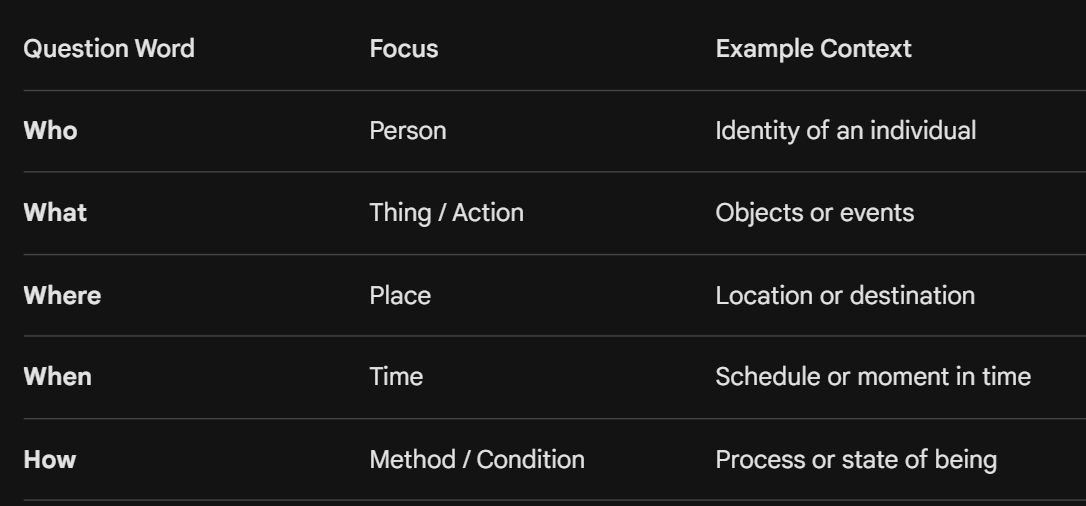
Summary Table for Quick Reference
To help you visualize how these tools function together, refer to this breakdown:
By practicing these five simple words, you turn passive listening into active discovery. Remember, every great journalist, scientist, and explorer started exactly where you are—by simply asking, "Who, what, where, when, and how?